- Entry type: Person
- Entry ID: AWE2609274
McMahon, Sonia
- Birth name Hopkins, Sonia Rachel
Also known as McMahon, Lady Sonia
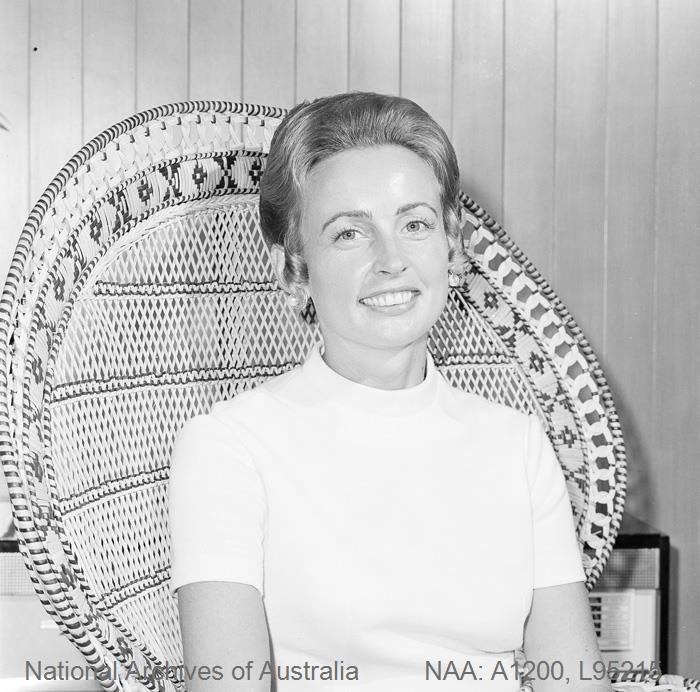
NAA: A1200, L95215
- Born 1 August 1932, Strathfield, New South Wales, Australia
- Died 2 April 2010, Darlinghurst, New South Wales, Australia
- Occupation Charity worker, Occupational therapist, Philanthropist
Summary
Sonia McMahon was born on 1 August 1932 and educated in Sydney at Ravenswood School for Girls in Gordon and Methodist Ladies’ College in Burwood. She trained and worked as an occupational therapist, then following stints as a colour consultant and an agent for P&O -Orient Lines, she accompanied a friend to New York where she secured a job with the Australian News and Information Bureau. During a trip to Jamaica, she was offered a position as assistant to a location manager there for Twentieth Century Fox. Soon after her return to Sydney, in early 1965, she met William McMahon, the then Minister for Labour and National Service. They married in December 1965; with his political career dominating their lives until his election loss in 1972. From the late 1970s, she was involved as a consultant and
director in fashion houses. Crediting her mother for involving her in charitable endeavours, Sonia McMahon supported many health and welfare organisations. Early in 2009 she was severely injured in a fall and later that year she received treatment for cancer. Admitted to intensive care late in March 2010, she died on 2 April.
Details
Sonia Rachel Hopkins was born on 1 August 1932 at ‘Borambil’, the house of her maternal grandparents, at 86 Redmyre Road in Strathfield. She was the second daughter of Rachel May Matchett (1897-1974) and William Edward Hopkins (1891-1974). Her older sister, Merelyn May Hopkins, later Wallace (1930-2012), was twenty months her senior.
Sonia Hopkins was born into an affluent life. Her maternal grandfather, W G Matchett, was a wealthy pastoralist. Her maternal grandmother, Lilla Matchett, also had considerable pastoral interests and left her estate for the benefit of her two daughters and their children. Sonia’s association with the land was of such strength that William McMahon accounted her an authority on the farming of sheep and cattle. Sonia’s father was a textile merchant, importing fabrics from Britain. Her mother, a devout Methodist, owned and managed several rural properties and was involved in charitable work.
In mid-1937 Sonia Hopkins joined her sister Merelyn as a day girl at Methodist Ladies’ College at Burwood. When Merelyn was enrolled at the school the previous year, she became the first third generation student to attend it (following her mother, aunts and grandmother). In mid-1938, when the family moved to 26 Powell Street in Killara, the Hopkins sisters began at Ravenswood College in Gordon, with Sonia in Kindergarten. The Ravenswood Magazine for 1942 published a short poem by 10-year-old Sonia, noted her participation on the piano in a concert and a recital and recorded that she had been a class captain for two terms. She returned to MLC Burwood as a boarder in 1946, completing 2nd to 5th form there. She was a keen swimmer, a member of the Sports Committee in 1949, and a (Boarding) House Prefect. She did the Intermediate Exams in 1947 and the Leaving Certificate in 1949 having secured ‘Bs’ in English, Modern History, Art and Physiology & Hygiene.
Armed with the Leaving Certificate, in 1950, Sonia Hopkins enrolled in a diploma in Occupational Therapy. One of her practical placements was at Callan Park, a psychiatric hospital in Lilyfield. Her first job was at St Vincent’s Hospital in Darlinghurst following which she started her own private practice. In April 1953, the Hopkins family sailed for England for an extended holiday with Sonia celebrating her 21st birthday in Norway. Soon after the family’s return to Sydney, her engagement to David Campbell Cathels was announced with the wedding planned for September 1954. The wedding did not proceed.
In 1956 Sonia joined Taubmans Paints Ltd as a consultant in its Colour Service, established to promote the benefits of colour in office, domestic, industrial and educational environments. At the end of the decade, she moved to the P&O-Orient Lines for two or three years – during this period she travelled overseas to the East, Japan, Singapore and Hong Kong and twice to Britain and the Continent.
In 1963, she accompanied a friend to New York where she secured a position in the News and Information Bureau in the Australian Consulate-General. A year later, while on holiday in Jamaica, she was offered a job with Twentieth-Century Fox Films as Assistant to the Location Manager on the film High Wind in Jamaica. She returned to Australia, at the beginning of 1965.
Sonia Hopkins met William McMahon in April 1965 at a fund-raising event organised by the Rum Runners, a charity supporting Sydney Hospital, at which he officiated and on whose committee she had previously served. They became engaged in October and married on 11 December. William McMahon had been a Minister in the Menzies Government since 1951 and was the Minister for Labour and National Service when they met. He subsequently held the Treasury (1966-1969) and Foreign Affairs (1969-1971) portfolios, before becoming Prime Minister in March 1971, losing office in December 1972. The first seven years of their married life were dominated by these senior appointments and the birth of their children: Melinda Rachel in November 1966, Julian Dana William in July 1968 and Deborah in September 1972.
McMahon’s electorate of Lowe was in the inner western suburbs of Sydney, and they made their home in the city’s eastern suburbs. Parliamentary business required his presence in Canberra and Ministerial responsibilities involved frequent travel. Sonia McMahon reflected that she ‘loved being with Bill and I loved being a mum’ (quoted by Susan Mitchell, Stand by Your Man, p. 29) but the realities of keeping the family together was disruptive for all. She decided to have the children cared for at home in Sydney while she accompanied her husband to Canberra and on his frequent domestic and international travels.
She had joined the Killara Branch of the Young Liberals in 1950. In later interviews she ascribed her membership as having little to do with political allegiance and more with the social life that it offered. Marriage immersed her in government and party-political matters, all of which she found absorbing. She said that William McMahon discussed everything with her. She was a fixture in the galleries in Parliament House and read many official papers. She considered her contribution to be ‘talking to people and passing on information’. The political diaries of Peter Howson, also a Minister in the Menzies, Holt and McMahon governments, document her presence at informal discussions and dinners, and at official functions. They note her ability to communicate with and influence McMahon’s colleagues and their wives and that she often contacted William McMahon’s colleagues to seek information to pass on to him. William McMahon esteemed her political judgement, appreciating her calmness and good sense. His eventual support for lifting the bar on the employment of married women in the public service and increased funding for mothers and families in the budget may have resulted from her counsel. In the fraught lead up to the 1972 election, she campaigned with him, rewrote his speeches and, according to his senior campaign adviser, knew that the Coalition would lose but ‘was the picture of smiling confidence’ and William McMahon’s rock (Susan Mitchell, p. 45). Not only was she integral to the campaign, William McMahon noted that his in-laws gave him considerable financial help to campaign ‘when I was deserted by the Federal Liberal organisation’ (NLA MS 3926, 19/7).
In December 1972 the Australian Labor Party formed Government and William McMahon, having lost both government and leadership of the Parliamentary Liberal Party, sat on the opposition frontbench without a shadow portfolio. Dismissed from the frontbench in May 1974, he became an opposition backbencher until his retirement from the parliament in 1982.
At the conclusion of their time in The Lodge, the McMahon children were aged six, four and three months. Political obligations and the intensity of public scrutiny receded in favour of routines based on family life, schooling and broader social contact. Once all their children were in school, Sonia McMahon became a consultant in 1979 to Christian Dior boutiques in Australia. Three years later she left that role to become a director at Louis Ferraud; then becoming a director of Tinine Pty Ltd, a company importing European fashion. Perhaps it was inevitable that the daughter of a textile importer would be drawn to fashion, and it seems that an interest in fashion was something she shared with her husband. William McMahon was accounted a dapper dresser, and she often credited him with advising her on her wardrobe. Her interest in fashion was lifelong, and she was frequently in the audience at fashion parades, often appeared on the runway for charity fashion events, featured in the 2004 Charlie Brown campaign and was distinguished for her modish appearance. The single fact that most people recall about Sonia was the white crepe dress she wore to the Presidential Dinner at the White House given in honour of the McMahons on 3 November 1971. The formality of the occasion combined with the seeming daring of the dress and the attractiveness of its wearer created a media sensation.
Sonia McMahon was no stranger to publicity from early in her life. The Matchett and Hopkins families were often mentioned in newspaper reports. On leaving school, social columns referred to her and, from the announcement of her engagement to William McMahon, she became a familiar presence in magazines and newspapers. Beryl Beaurepaire, Chairman of the Federal Women’s Committee of the Liberal Party, wrote in her letter of congratulations ‘Australia will love having a PM with a glamorous wife and young children’, acknowledging the public and political utility of media interest (NLA MS 3926, 1/65). However, for someone as guarded as Sonia, its intensity, and frequent slyness, must have been testing.
Crediting her mother for involving her in charitable work, Sonia McMahon was a lifelong supporter of, and organiser for, health and welfare charities. In February 1998, when facing a drink driving charge, her lawyer argued successfully that her work on behalf of twenty-six organisations had helped to raise some $62 million and that this should mitigate the charges (The Australian, 4.2.1998, p. 12). The organisations she supported included the Australian Cancer Research Foundation (she was a Founding Trustee and Life Member), Careforce, the Cornucopia Committee (Patron), the Crippled Children’s Association (Patron), Crown Street Hospital ‘Baby Bunting’, Dental Health ‘Pros and Cons’, Foundation 41, the Microsearch Foundation, the Miss/Mrs Australia Awards, the National Brain Foundation, the Order of St John appeals, the Sudden Infant Death Syndrome Association, Sydney Children’s Hospital Foundation, and the Sydney Hospital ‘Rum Runners’.
William McMahon died on 31 March 1988. Now in her mid-fifties and without financial concerns, Sonia continued her charitable work, maintaining a strong social circle and interest in the Liberal Party. With her children aged from sixteen to twenty-two, her family remained central to her, particularly as her youngest dealt with mental health issues which led to periods of estrangement.
In February 2009, Sonia McMahon fell on businessman Paul Ramsay’s yacht on Sydney Harbour suffering broken ribs, a punctured lung and fractures and spent several weeks in hospital. In July, she had a cancerous melanoma removed from her left arm and in September the lymph glands were removed from under that arm. In March the following year she was admitted to intensive care in St Vincent’s Private Hospital, dying on 2 April.
As probate records are not available for her estate, no precise assessment can be made of her financial position or net wealth. The couple owned property in the eastern suburbs of Sydney and, through her mother, she inherited the property Ashleigh Park near Orange. Soon after her death her portfolio was estimated to have been worth $30 million (Sydney Morning Herald, 12.6.2010).
Sonia McMahon was curious, sociable and hard working. She brought good counsel, glamour and loyalty to her marriage and partnership with William McMahon who believed his political legacy had never been fairly assessed. Susan Mitchell argued that he knew he would not have become Prime Minister without her (Susan Mitchell, p. 144). While he was alive, she combined grace with a determined public silence on matters political. After his death she remained staunch in his defence.
Archival resources
- National Library of Australia, Manuscript Collection
- National Archives of Australia, National Office, Canberra
- National Portrait Gallery
- University of Sydney Archives
- Powerhouse Museum
Published resources
- Book
- Article