- Entry type: Person
- Entry ID: AWE26100820
Bellamy, Suzanne
- Dr, PhD
- Full name Bellamy, Suzanne Margaret
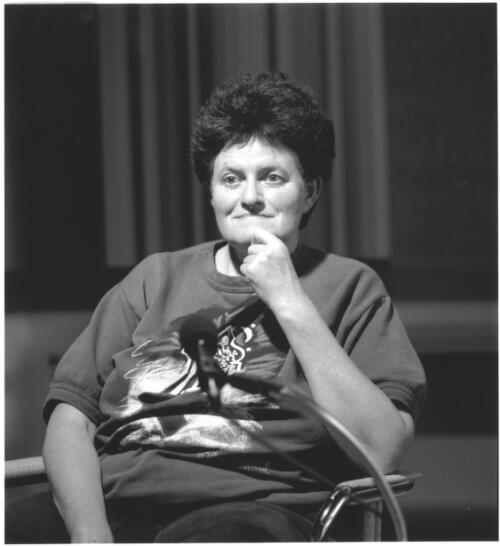
Photographer: Damian McDonald
- Born 22 September 1948, Parramatta, New South Wales, Australia
- Died 20 June 2022, Braidwood, New South Wales, Australia
- Occupation Artist, Women's liberationist, Writer
Summary
Dr Suzanne Bellamy was a founding participant in Sydney Women’s Liberation. After an early career in academia, she moved to country New South Wales to become an artist and independent scholar. A lesbian feminist, Bellamy chose to explore an independent life ‘living inside the patriarchy, engaged with community and pushing boundaries’.
Details
Suzanne Bellamy was born in Parramatta to a working class family; her parents were Valeria (neé Freeman) and Alan
Bellamy. She was educated at North Parramatta Infants and Primary schools and Macarthur Girls High School. True to her origins, she remained a lifelong Parramatta Eels rugby league club supporter.
After winning a Commonwealth University Scholarship, Bellamy undertook studies in History at the University of Sydney, graduating with Honours. She began postgraduate studies, but abandoned Sydney University believing the History Department was hostile to Women’s Studies. In 1974 she began working as a research assistant and tutor at Macquarie University, teaching Politics and Women’s Studies in the School of History, Philosophy and Politics. She left in 1979 to work full time as an artist and writer.
Bellamy attended the first meetings of Sydney Women’s Liberation in 1969, becoming very involved and working almost
full time at Women’s Liberation House at 67 Glebe Point Road, Glebe. She joined the collectives which published the newspaper MeJane and the journal Refractory Girl. She was National Convenor of the first Woman and Labour Conference in 1978, worked on all three Australian Women’s Commissions, on child welfare campaigns with her friend and fellow Glebe resident Bessie Guthrie, contributed to the ABC Radio Coming Out Show and the 1978 women’s theatre production The Awful Truth Show, as well as many other projects and campaigns. She began to identify as a lesbian in 1970. Bellamy later moved to country New South Wales, living first at Bredbo and then Mongarlowe.
First exhibiting in 1981, and primarily known for her ceramic sculptures, Bellamy also worked in printmaking, painting, art and text fusions. Spinifex Press used several of her art works as cover designs, beginning with Susan Hawthorne’s The Falling Woman in 1992. Bellamy contributed to several Spinifex anthologies including Australia for Women: Travel and Culture, A Girl’s Best Friend: The Meaning of Dogs in Women’s Lives, Cat Tales: The Meaning of Cats in Women’s Lives and Radically Speaking: Feminism Reclaimed.
Always fascinated by archaeology, in 1996 Bellamy created the art performance installation The Lost Culture of Women’s Liberation, 1969-1974, the Pre-dynastic Phase, which she called an activist women’s history project. The Lost Culture was first exhibited at the sixth International Congress on Women in Adelaide and has been presented multiple times in Australia and the United States as a slide/performance format. Bellamy wrote it: ‘combined art practice and history with archaeological methodology, in a futurist comic format … In its museum format it includes models and artefacts, photography, documents and constructed displays, set in a time frame 500 years in the future, as an archaeological dig of an urban site in Sydney. I created the character of Professor Dame Hildegarde Gumbutas, an Oxford Professor, loosely based upon Marija Gimbutas, who performs the launch of the dig/installation.’ A recording of its performance at the National Library of Australia for the Feminism and the Museum Symposium, 2 November 2013 is available at: https://www.youtube.com/watch?v=UC4w4Hnw5QI&t=91s.
Suzanne began travelling to the United States in the 1990s, initially to attend the Minnesota Women’s Music Festivals where she worked as a set painter and graphic artist from 1990 to 1994. Long a devotee of Virginia Woolf, in 1997 after publishing an essay in Barrett and Cramer, Virginia Woolf: Lesbian Readings, she was invited to present at the International Virginia Woolf Conference in New Hampshire and thereafter attended many Woolf conferences, the last one as part of an online panel, ten days before her death. Her PhD thesis, awarded by the University of Sydney in 2018, was Textual Archaeology: a Contextual Reading of the 1942 Nuri Mass Thesis on Virginia Woolf. Her 2011 painting Woolf and the Chaucer Horse was acquired by the University of Glasgow.
Bellamy won the 2000 Edna Ryan Award for creative feminism. In 2020 Catherine Dyer included Bellamy for her documentary film on Women’s Liberation in Australia, Brazen Hussies. Suzanne Bellamy died in Braidwood on 20 June 2022.
Archival resources
- National Library of Australia, Manuscript Collection
-
National Library of Australia, Oral History Collection
- Suzanne Bellamy interviewed by Biff Ward in the History of the Australian Women's Movement Oral History project 2017
- Suzanne Bellamy interviewed by Biff Ward in the History of the Australian Women's Movement Oral History project 2000
- Suzanne Bellamy interviewed by Biff Ward on 'This is Your Changing Life' 2XX radio program July 1977
- Suzanne Bellamy interviewed by Biff Ward on 'This is Your Changing Life' 2XX radio program Dec 1977
- National Portrait Gallery
Published resources
-
Biography
- Suzanne Bellamy, https://daao.org.au/bio/suzanne-bellamy/biography/