- Entry type: Person
- Entry ID: AWE23090744
Waterhouse, Dawn
- OAM
- Birth name Calthorpe, Allison Dawn
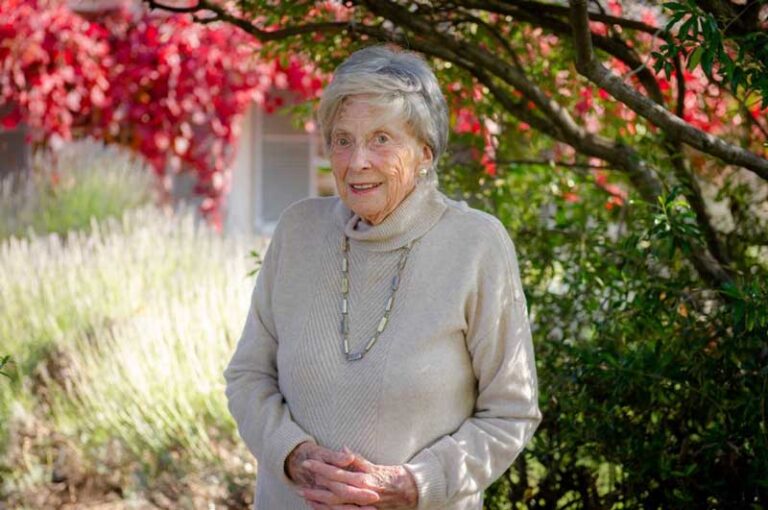
- Born 15 December 1923, Queanbeyan, New South Wales, Australia
- Died 28 December 2025, Canberra, Australian Capital Territory, Australia
- Occupation community Historian, Homemaker, Laboratory assistant
Summary
In her long life since her birth in 1923, Dawn Waterhouse was a participant in the development of the Canberra community and the city’s evolution as the National Capital from the transfer of the Commonwealth Parliament to Canberra in 1927 to the present day.
Dawn Waterhouse was inscribed on the ACT Honour Walk in 2019.
Details
Dawn Waterhouse, laboratory assistant, housewife, mother, Canberra identity, community participant and community historian, was born Allison Dawn Calthorpe in Queanbeyan New South Wales in 1923, the younger daughter of Della (Dell) and John Henry (Harry) Calthorpe. Dawn’s mother, Della Ludvigsen, was born in Sydney of an American mother and Norwegian father. Dawn’s father, Harry Calthorpe, born at Drake near Tenterfield, New South Wales, lived in Glen Innes and Cootamundra as a young man. He gave his occupation as pastry cook when he enlisted in the Australian Imperial Force (AIF) on 19 August 1914 just three weeks after the beginning of World War I. He trained in the Middle East and was seriously wounded at Gallipoli on 2 July 1915 while serving with the 1st Light Horse. Struck in the lower jaw by a fragment of a radio hit by a high explosive, his jaw shattered and he lost all but two teeth, leaving him, at that time, unable to chew solid food. After being hospitalised in Egypt for his injuries and shell shock, he was repatriated to Australia towards the end of 1915. After extensive medical treatment in Concord Repatriation Hospital, he became a recruitment sergeant in the Southern Tablelands.
Harry married Della Ludvigsen in Sydney in 1917 and they had two daughters, Del and Dawn. Dawn described her mother as a modern woman who loved Sydney where she was a roller-skater and dancer. She disliked living in Baidwood, one of their early homes, but became proud of Canberra; she had no affinity for horses but, from the late 1920s, loved driving her own car, a Morris Cowley that bore the number plate ACT 51. Dawn’s father suffered very much from his war injuries, but he was a happy person, a good swimmer and horse rider, and played the cornet. After walking off a soldier settlement block at Braidwood, on poor farming land infested with rabbits, Harry Calthorpe became a stock and station agent in Queanbeyan. Soon after, he joined a firm begun by William George (Bill) Woodger and his brother Tom, which became Woodgers & Calthorpe. The firm was joint auctioneer at the auction of the first group of Canberra business and residential leases held on 12 December 1924 at Camp Hill, close to where Parliament House now stands. Registered as a limited company in 1927, Woodgers & Calthorpe continued acting for the Commonwealth in the sale of Canberra leases for the next 35 years.
When Dawn was three, she attended the opening of the Provisional Parliament House (now Old Parliament House) on 9 May 1927 by the Duke of York. She remembered being taken for a joy ride with her family by pioneer aviator Charles Kingsford Smith when he flew to Canberra in his famous aeroplane the Southern Cross a couple of years later. In 1927, the Calthorpe family moved from Queanbeyan to their Canberra home built at 24 Mugga Way on a block Harry Calthorpe bought at one of the first auctions of house leases. Dawn remembered Canberra as just a paddock, but her father assured her, ‘One day this will be a city’. The town’s 9000 residents struck hard times during the Great Depression when the development of Canberra virtually ceased. In an effort to combat moves to abandon Canberra as the National Capital, Bill Woodger and Harry Calthorpe joined a small group named the Kangaroo Club which aimed to ‘keep Canberra hopping’. Both invested in Canberra businesses and, through the Canberra Building & Investment Co. Ltd, were active in the development of the Sydney and Melbourne buildings, the nucleus of Canberra’s future city centre. Dawn’s childhood memories were of riding bikes, looking for fossils at Mugga, swimming in the Cotter River, and roaming wherever she liked. One day she walked from Red Hill to Mount Ainslie and back, a ‘long way’ and ‘such an adventure’. The opening of Manuka Swimming Pool in 1931 was a very clear memory as a sign of the advent of a modern city. ‘Dad bought us season tickets at the cost of 12/6 … it was absolutely wonderful.’ She enjoyed films at the Capitol Theatre Manuka, concerts at the Albert Hall, and celebrations for Empire Day and Wattle Day.
The Calthorpe family house was designed by Oakley and Parkes under the direction of architect Ken Oliphant. The firm won a national competition to design houses suitable for the national capital and were the designers of the Prime Minister’s Lodge – the Lodge and 24 Mugga Way had identical bathrooms. On one memorable trip to Sydney Dell Calthorpe ordered almost all the furniture and many household items from the Sydney firm Beard Watson & Co. Little was changed over the following decades which explains why the house was described as ‘a time-capsule’. Dawn grew up in a comfortable, fashionable house with her own bedroom where she kept her toys. In the back garden there was a special cubby house furnished with a wood stove, chairs and boxes for toys. Originally one of the huts built as temporary accommodation for Canberra’s early construction workers, Harry Calthorpe bought it as a playhouse for his daughters. Their home was very cold – it was Dawn’s job to collect the kindling – and even though there were two large fireplaces and a fuel stove in the kitchen, the warmth hardly reached the bedrooms and they often suffered from chilblains. The Calthorpe children were brought up strictly, punctuality being especially important. They saw the handle of the feather duster for any infringement of rules. Both parents placed great emphasis on the attractive presentation of meals and good table manners. As the family had many country friends and had their own chooks, red meat and white meat were plentiful. The family enjoyed vegetables and fruit from the garden and mushrooms picked in nearby paddocks. The Great Depression of the 1930s impacted the family. When Dawn asked her father what ‘prosperous’ meant, he said it was when you could afford to go on holidays. The family’s holidays at Narooma ceased during the Depression but her parents used to say, ‘Oh well, we’ve got a lovely garden, we’ll holiday in he garden’.
Dawn began her schooling at Telopea Park public school in Barton and remained there during the Depression. In these early years, Dawn maintained a competitive relationship with her sister Del, exacerbated when, during these difficult years, her sister, a high achieving student, was able to stay at the fee-paying St Gabriel’s school. Opened in 1926 by Anglican Sisters of the Church in the old St John’s Rectory near Glebe Park, it soon moved to its permanent site in Melbourne Avenue, Deakin, followed by a name change to the Canberra Church of England Girls’ Grammar School. In 1937, when there was more money after the stringent times in the Depression years, Dawn, who described herself as a daydreamer as a student, achieved her wish to be enrolled at Girls’ Grammar and soon flourished. That year she was a member of the Junior Athletics team and in 1940 she was a prefect. She loved Grammar, especially her time in the boarding house, and remembered the teachers long after.
When she left school, ‘all the boys were heading off to the war so the girls got the jobs’. Dawn was employed as a laboratory assistant at the entomology division of CSIR (Council for Scientific and Industrial Research, the forerunner of CSIRO). She did lots of experiments feeding mosquitoes and grasshoppers and she learnt how to crutch sheep and drive a gas producer, an improvised wartime attachment that enabled cars to run without relying on petrol, which was rationed. Part of her work on grasshoppers took her to Trangie in the central west of New South Wales. Her boss was her future husband, entomologist Douglas Woodhouse, and she worked with him on research on blowflies. Waterhouse became chief of CSIR’s entomology division during World War II and served as a captain in the Australian Army Medical Corps. He was posted to Cairo for about six weeks from the beginning of December 1942 and to the mouth of the Lakekamu River in the Gulf Province of New Guinea from August to October 1943, testing mosquito repellent and engaged on other medical research projects. He was the inventor of the insect repellent known commercially as Aerogard. Dawn Calthorpe and Douglas Fred Waterhouse, who was the elder son of Professor and Mrs E.G. Waterhouse of the Sydney suburb of Gordon, married in St John’s Anglican Church, Reid, ACT in March 1944. Eighty guests attended the wedding reception held at the Calthorpes’ home in Mugga Way. ‘Doug was a very plain man,’ Dawn said years later, ‘but absolutely the most witty and very clever. I loved him so much.’ Once she married, Dawn, like all married women, was barred from returning to work in any government job. She was lonely, particularly when Doug went to Cambridge, and she spent the time knitting and reading. They built a house in Dominion Circuit Deakin, which remained Dawn’s home until quite recent years. After the birth of their daughter Jill, Dawn suffered several miscarriages and the births of the three boys, Douglas, Jonathon and Gowrie, occurred over the next seventeen years. In the early 1960s, the family accompanied Doug to Yale where he had an academic appointment. While raising a family, Dawn had a job with the blood bank, joined the Red Cross, the Canberra & District Historical Society and was a member of the first committee of the Children’s Medical Research Foundation. In 1954 she was invited to arrange the flowers for the visit of Queen Elizabeth to the Provisional Parliament House. Then she was asked to do the flower arrangements for the Queen Mother’s visit and Princess Margaret’s visit. ‘I had a bit of a flair with flowers,’ she said.
After Harry Calthorpe died in 1950, Dawn’s mother remained living in the Mugga Way house until shortly before her death in 1979. In the mid-1980s, with increasing awareness of the loss of Canberra’s heritage, the Commonwealth Government bought 24 Mugga Way. Now one of three heritage houses administered by the ACT Heritage Houses Trust, Calthorpes’ House is preserved as a window into a family’s life in the 1920s–1950s period. It follows a historical timeline from the ACT’s other heritage houses: Lanyon from the convict and squatter era and Mugga Mugga from small settler times. Calthorpes’ House is a treasure house of domestic history. It houses the gramophone, pianola, records and bridge cards reflecting the family’s entertainments and pastimes, and the original furniture. The Calthorpes bought some new household gadgets, a toaster, iron and fan, but they persevered with an ice chest with blocks of ice delivered regularly and a wood-fired copper with a copper-stick to transfer the boiling clothes to the laundry sink, and a bag of blue for bleach. In harmony with Canberra’s planned garden city design, their house is set on a large block with a formal front garden and a large back garden with vegetable plots and an orchard, and they kept chooks which it was Dawn’s job to feed. Near the back fence is the wartime air raid trench and shelter which was big enough for two families in event of an enemy attack prior to a feared invasion during World War II. Dawn describes the early 1960s, when Canberra began a decade of rapid growth, as an exciting era. The sleepy Molonglo River was dammed, ready for the rains that turned it into Lake Burley Griffin. A new Commonwealth Avenue bridge straddled the lake and the low-level river crossings were submerged. The Defence departments began the long-planned move to the National Capital and their staff and families, at first reluctant to leave Melbourne, came to like living in Canberra. There were more embassies and Dawn attended embassy cocktail parties and arranged women’s programs for a couple of conferences. Construction was happening everywhere, the National Library on the southern shore of the lake, more buildings at the Australian National University on the northside, and the Royal Mint and new Defence buildings in other directions. Dawn developed an interest in Japanese flower arranging and met the Japanese ambassador’s wife. She felt she was at the top of Canberra society. She worked for school fetes and many other causes, including Legacy and the Red Cross, and at the same time she made clothes for her children.
In the early 1970s Dawn recalls that John Molony, historian at the Australian National University, and several Aboriginal people came to tea at 24 Mugga Way and Gough Whitlam, whom Dawn knew from schooldays when he was a friend of Del’s, raised the Aboriginal flag marking the first Aboriginal embassy. In 1972 the Aboriginal Tent Embassy was established opposite the Provisional (now Old) Parliament House. It is now an Australian Heritage site. Dawn was surprised by the Dismissal of the Whitlam Government with its new ideas in 1975. She believes Julia Gillard did well as Prime Minister; her view is that women are part of men’s strength and ideas. A Canberra patriot all her life, a few negative comments have made their way into Dawn’s published observations in recent years, beginning with her firm view on handling isolation during the Covid pandemic. Speaking from her long experience of living through the Great Depression, World War II, bush fires, drought and epidemics, particularly recurrent polio epidemics when no vaccine was available, she remarked: ‘When I was young and had chickenpox or measles, we had three weeks’ isolation. I think they are letting people out too early.’ In another interview she lamented the poor planning that had allowed parts of Canberra to be overwhelmed with concrete buildings. ‘I don’t like cement. I don’t like the overcrowding and I don’t like what seems to be disrespect for the city’s poorer citizens,’ she said. ‘Where has our community spirit gone? I’m so proud I’m a Canberra girl. If only they would stop building with concrete, they have lost the plot.’ On 14 June 2021 Dawn received the Order of Australia Medal (OAM) for her service over many years to community history. Stylish and always carefully groomed, Dawn defied her age. In 2022, when she gave a talk at the October meeting of the Canberra & District Historical Society, she was offered a chair and a microphone but did not need either. Her topic was ‘Canberra and Blowflies’, and her collaboration with her late husband in his work on the eradication of blowflies. Dawn’s secret for a long life was ‘always be involved in something’ and face life with a ‘positive attitude’ – ‘keep busy’.
Published resources
-
- Dawn Waterhouse recalls a bygone era and rich memories of Canberra’s past, Genevieve Jacobs, 2020
- Dawn’s seen it all, but not like this, Sally Pryor, 2020
- Feisty, fond memories from Dawn of Canberra, Belinda Strahorn, 2021
- A 'dead end' has plenty of soul: Canberra had few early admirers but it did have happy inhabitants says Dawn Waterhouse, Dawn Waterhouse, 1991
- Dawn Waterhouse OAM, 2021