- Entry type: Person
- Entry ID: AWE1149
Bon, Anne Fraser
- Maiden name Dougall, Anne Fraser
Also known as Bon, Ann
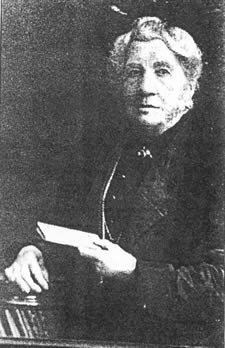
- Born 9 April 1838, Dunning, Perthshire, Scotland
- Died 5 June 1936, Melbourne, Victoria, Australia
- Occupation Advocate, Pastoralist, Philanthropist
Summary
Anne Fraser Bon had just turned twenty and was newly married when she arrived in Victoria, from Scotland, in 1858. Her husband, John, who was twenty-eight years her senior, was already well-established in pastoralism at Wappan Station in the Bonnie Doon area of south-eastern Victoria. Anne accompanied him to what was then a remote area and bore five children in quick succession. She was widowed at the age of thirty, in 1868, when John Bon died of a heart attack.
Unusually for a women, after her husband’s death, Anne Bon assumed management of the station. She was also unusual amongst her peers for her attempts to act on the behalf of the indigenous people of the region. A devout Presbyterian and humanitarian, Anne Bon supported Aborigines’ resistance to increasing state regimes of control and surveillance. While some of her ideas and goals for the ‘improvement’ of Aboriginal people now seem paternalistic and outdated, many members of indigenous communities nevertheless expressed gratitude for her assistance in thwarting if not defeating the diminution of Aboriginal entitlements and civil rights. It was a cause she remained actively committed to until her death in 1936.
Details
Known locally as ‘The Widow of Wappan’, after the death of her husband, Anne Bon was a formidable woman who fought strenuously to protect the limited rights of Aboriginal people, a cause her husband had also supported while he was alive. Wappan offered sanctuary to indigenous people, and was a port of call for elders in their travels. It was while he was travelling that William Barak, an important indigenous leader of the nineteenth century, met Anne Bon. They formed a special relationship born from a sense of shared loss – both had experienced the death of a child.
Anne Bon kept in contact with William Barak when he settled in Coranderrk, Healesville. When her husband John died in 1868, she was determined to raise her four children and continue to run Wappan Station. She also bought a house in Kew, Melbourne and would regularly catch the train from Bonnie Doon Station to Melbourne to attend to business matters.
It was to her Kew residence that William Barak brought his dying son in 1881. Anne helped William take his son to the Melbourne Hospital but he died soon afterwards. This tragedy spurred Anne on to pressure the Victorian government into conducting an inquiry into the management of Coranderrk Mission. She was a copious letter writer and became a thorn in the side of the Board for the Protection of Aborigines (BPA).
When her efforts at changing conditions for Aborigines proved fruitless, she then tried to influence government policy from within. She became the first woman appointed to the Board for the Protection of Aborigines (BPA) in 1904, holding this position until her death in 1936.
A measure of the extent to which Anne Bon valued her relationship with indigenous people in general and respected William Barak in particular can be seen in the way she commemorated Barak after his death. When her husband died, Bon had a monument constructed in his honour, upon which she mounted his name and that of the child who passed away. When Wappan was compulsorily acquired by the State Rivers and Water Commission to be flooded and make way for the Eildon Weir, Anne Bon decided that she should move this monument. At the same time, William Barak passed away. Anne engaged some tradespeople to scratch from this monument her husband’s name and her child’s name, and re-inscribe it in memory of William Barak. That monument is now located in the Coranderrk Aboriginal cemetery.
Anne Bon’s philanthropic activity was wide in scope. In addition to her work for the local Indigenous population, she used her money to convert her Kew home into a refuge for the sick and needy. She gave generously to the Austin Hospital and served on its ladies’ committee. She was also a member of the first committee of the Charity Organisation Society, and a supporter of the Salvation Army throughout her life. She set up a school in Melbourne for Chinese children. She gave substantial donations to Presbyterian churches in Mansfield and Bonnie Doon. She brought patients from state mental institutions to stay at Wappan where they could enjoy the comforts of her home life. During WWI she donated an ambulance to the Belgian Army – for which she was decorated by King Leopold in 1921 – and gave £20 to every blinded soldier in Victoria at Christmas time each year.
Anne Bon retired to the Windsor Hotel, Melbourne, where she lived the last years of her long life.
Archival resources
Digital resources
- Title: Anne Bon
- Type: Image
- Date: 3 May, 2023
Published resources
-
Resource Section
- Ten Victorian Women, Public Record Office Victoria, 2005, http://womenaustralia.info/exhib/fl/flten06.htm
- Anne Bon - Project Wappan, Matthew, Heather, 2003, http://www.mansfield.vic.gov.au/projectwappan/index.html
- A Great Form of Love: Women Philanthropists in Australian History, Lemon, Barbara, 2008, http://www.abc.net.au/rn/hindsight/
- Bon, Ann Fraser (1838 - 1936), Gillison, Joan, 2006, http://www.adb.online.anu.edu.au/biogs/A070343b.htm
-
Book
- Rebellion at Coranderrk, Barwick, Diane, 1998
- Letters from Aboriginal Women in Victoria, 1867-1926, Nelson, Elizabeth, Smith, Sandra and Grimshaw, Patricia, 2002, http://hdl.handle.net/11343/42073
- The Widow of Wappan: The Story of Ann Fraser Bon and the Wappan Project., Matthew, Heather, 2003
- Thesis
-
Site Exhibition
- In Her Gift: Women Philanthropists in Australian History, Australian Women's Archives Project, 2009, http://www.womenaustralia.info/exhib/wiph/home.html
- The Encyclopedia of Women and Leadership in Twentieth-Century Australia, Smart, Judith and Swain, Shurlee (eds.), 2014, http://www.womenaustralia.info/leaders
- Resource