- Entry type: Person
- Entry ID: AWE1134
Clarke, Janet Marion
- Lady
- Maiden name Snodgrass, Janet
Also known as Lady Janet Clarke
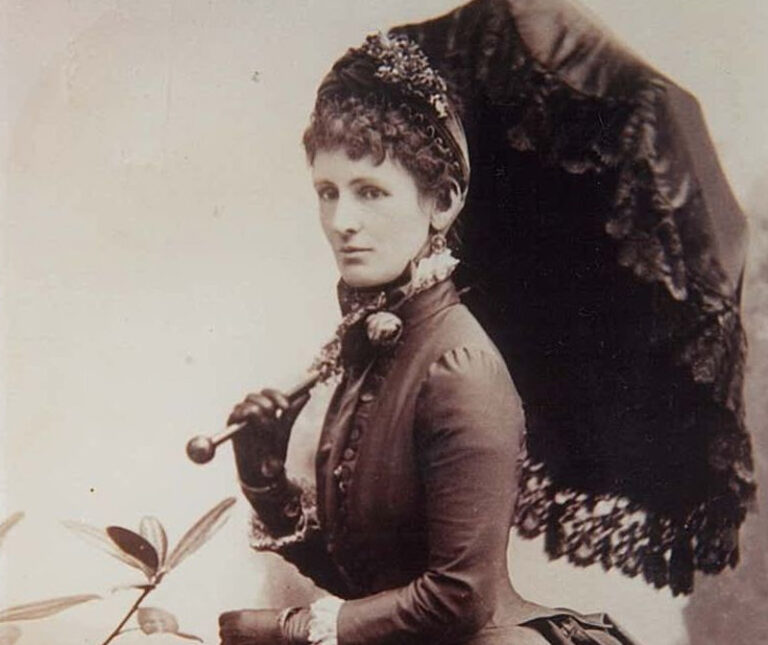
Lady Janet Clarke, of Rupertswood, Sunbury, Victoria circa 1880
- Born 4 June 1851, Yea, Victoria, Australia
- Died 28 April 1909, East Melbourne, Victoria, Australia
- Occupation Philanthropist, socialite
Summary
Janet Clarke (née Snodgrass) was a society hostess and leading patron of good causes in Melbourne from the 1880s until her death. She was a member of the Charity Organisation Society, the Austral Salon, the Melbourne District Nursing Society, the Talbot Epileptic Colony committee, the Alliance Française, the Dante Society, the Women’s Hospital Committee, the Hospital for Sick Children and the City Newsboys’ Society. She helped to organise the Women’s Work Exhibition in 1907. Clarke’s influence was such that she became the first president of the National Council of Women of Victoria in 1902, and of the Australian Women’s National League in 1904.
Details
Born at Doogallook station on the Goulburn River, Janet was the daughter of Peter Snodgrass, described by Michael Clarke as ‘a fearless horseman’ but also as ‘a neglectful manager and an unfortunate politician [who] left his widow and nine children destitute’. Following her father’s death, Janet was given tutelage by Arbella Winter-Cooke at ‘Murndal’, near Hamilton, before taking up a post as a companion for Mary Clarke and her children in Sunbury in 1869. On 12 April 1871, however, the pregnant Mary Clarke fell from a pair-horse buggy. She suffered a miscarriage and died the same day. Janet remained at the property to care for the Clarke children. In 1872, at twenty-one years of age, she became engaged to William. The pair were married on 21 January 1873. The following year, William inherited the vast fortune of his father, pastoralist W.J.T. ‘Big’ Clarke. Janet Clarke, a novice to the combined role of wife and society hostess, was thrown into Melbourne’s elite social circle. Years later, Michael Clarke would note that his grandmother was ‘conscious of her deficiencies. She covered her ignorance by being a good listener. She concealed her lack of social know-how by being a thoughtful hostess and a cautious guest. She was deferential to her elders and betters, kind to nervous young ladies and considerate to servants’.
Sir William and Lady Janet Clarke, as they became, had eight children: Clive Snodgrass (1873), Mary Janet (1874), William Lionel Russell (1876), Agnes Petrea Josephine (1877), Francis Grenville (1879), Reginald Hastings (1880), Lily Vera Montagu Douglas (1883), and Ivy Victoria (1887). Though Petrea (or ‘Josie’ as Janet referred to her) died in infancy, William had four children from his first marriage and theirs was a full house. As early as August 1874 the foundation stone was laid for the building of Rupertswood, the family home in Sunbury, with initial costs estimated at £20,000. Cliveden, their East Melbourne mansion, was commissioned in 1886 and became a hub of social and charitable activity.
Though the story is contested by some, legend has it that Janet Clarke holds a special place in the history of the Ashes Test series. In 1882 Ivo Bligh led a team from England to play three cricket test matches in Australia. The team spent Christmas at the Clarke property, Rupertswood, in Sunbury. After Rupertswood staff and Sunbury locals lost a social game to the English team, Lady Clarke apparently presented Bligh with a small urn containing the burnt ashes of the stumps and announced that she would like it to be a perpetual trophy between the two teams. The urn was donated to the MCC in 1927.
Janet Clarke was a giant in nineteenth-century charitable circles. An article entitled ‘Australian Lady Bountiful’ in Table Talk (1885) acknowledged her practical charitable work for the Melbourne District Nursing Society, and recounted the presentation of an address and bible together with a petition to Lady Clarke containing 400 signatures from ‘grateful working people’ expressing ‘our sincere thanks to you for your kindness and benevolence shown towards our sick and poor’. Punch magazine suggested that ‘most of the big charitable works which had been carried through to a successful issue in Melbourne… had their origins in Janet Lady Clarke’s ballroom’. On her death in 1909, the Leader pronounced that she ‘stood at the head and front of almost every philanthropic movement’. A century later, her philanthropic legacy remains among the most enduring in Victoria in the areas of education, the arts and social welfare.
Janet Clarke was particularly supportive of educational causes. She helped to establish the College of Domestic Economy (later the Emily McPherson College) and the Melbourne Church of England Girls Grammar School. She donated £6,000 toward the building of a hostel for women university students at Trinity College (University of Melbourne). The hostel provided the first separate residential accommodation for women students and was later expanded and renamed Janet Clarke Hall.
Despite her public activities, Janet Clarke did not support women’s suffrage and promoted domesticity as the ordinary woman’s natural duty. She did believe, however, that women’s maternal and domestic influence was needed outside the home. Once women had obtained the vote, she encouraged political awareness among her own acquaintances, and was instrumental in the establishment of the Australian Women’s National League.
Upon the death of her husband in 1897, Lady Clarke became known as Janet, Lady Clarke. Sir William’s baronetcy was inherited by his first son, Rupert, whose own wife took the title of Lady Clarke.
Archival resources
Digital resources
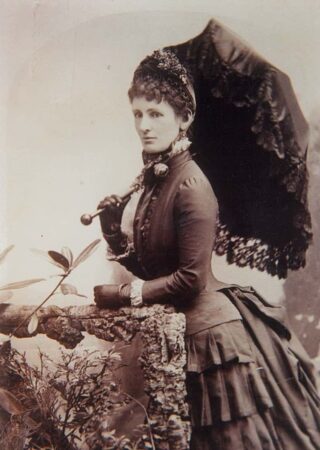
- Title: Janet Lady Clarke (seated)
- Type: Image
- Date: 3 May, 2023
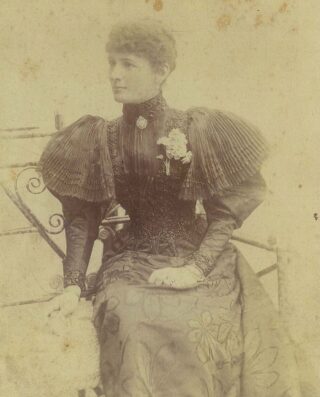
- Title: AWE1134gb.jpg
- Type: Image
- Date: 3 May, 2023
Published resources
- Book Section
-
Book
- Janet Clarke Hall, 1886-1986, Gardiner, Lyndsay, 1986
- Women of influence: the first fifty years of women in the Liberal Party, Sydenham, Diane, 1996
- Clarke of Rupertswood: The Life and Times of William John Clarke, First Baronet of Rupertswood, 1831-1897, Clarke, Michael, 1995
- Liberal women : Federation to 1949, Fitzherbert, Margaret, 2004
- Thesis
- Journal
-
Edited Book
- 200 Australian Women: A Redress Anthology, Radi, Heather, 1988, https://webarchive.nla.gov.au/awa/20071105022623/http://pandora.nla.gov.au/pan/78644/20071105-1315/www.200australianwomen.com/index.html
-
Site Exhibition
- In Her Gift: Women Philanthropists in Australian History, Australian Women's Archives Project, 2009, http://www.womenaustralia.info/exhib/wiph/home.html
- The Encyclopedia of Women and Leadership in Twentieth-Century Australia, Smart, Judith and Swain, Shurlee (eds.), 2014, http://www.womenaustralia.info/leaders
-
Resource Section
- Clarke, Janet Marion (1851 - 1909), Morrissey, Sylvia, 2006, http://www.adb.online.anu.edu.au/biogs/A030391b.htm
-
Resource
- Trove: Clarke, Janet Marion (1851-1909), http://nla.gov.au/nla.party-706099