- Entry type: Organisation
- Entry ID: AWE0501
National Council of Women of Victoria
(From 1902 – )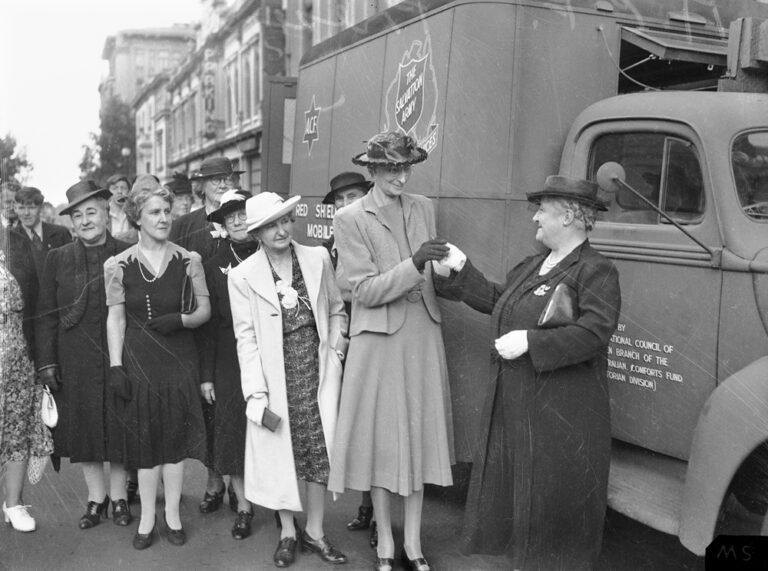
- Occupation Voluntary organisation
Summary
Officially founded in 1902, with Janet Lady Clarke as president, and continuing today, the National Council of Women of Victoria is an umbrella organisation for a large and diverse number of affiliated Victorian women’s groups. It functions as a political lobby group, attempting to influence local, state and federal government. Like all National Councils of Women, it operates though a standing committee system whereby specific issues are brought before the Council and, if there is general agreement that a question should be taken up, a subcommittee is established to investigate the matter.
Until the 1940s at least, the Council was a major focal point for women’s activism.
Its initial aims were:
1. To establish a bond of union between the various affiliated societies.
2. To advance the interests of women and children and of humanity in general.
3. To confer on questions relating to the welfare of the family, the State and the Commonwealth.’
While encompassing a diverse range of organisations, the Council emerged as a largely middle-class women’s organisation especially in terms of its office bearers.
Although not always an overtly feminist organisation, the NCWV drew on the conviction that women had a special contribution to make to public life and the formulation of social policy. They were thus concerned with a wide array of social reform issues** as well as those more directly related to the legal and social status of women. It also drew on notions of gender unity and international sisterhood.
[Kate Gray, ‘The Acceptable Face of Feminism: the National Council of Women, 1902-1918’, MA thesis, University of Melbourne, 1988.]
Details
Women’s organisations affiliated with the National Council of Women of Victoria have a wide range of goals and aims. Thirty five organisations were affiliated in 1902, and 139 by 1977 [Norris, p. 10-11]. These organisations include groups dedicated to philanthropic and reform causes, social and cultural societies as well as professional organisations. These included the Woman’s Christian Temperance Union, the Young Women’s Christian Association, the Australian Women’s National League, the League of Women voters of Victoria, the Women’s International League for Peace and Freedom, the Business and Professional Women’s Club of Melbourne, the National Council of Jewish Women, the Union of Australian Women, the Royal Australian Nursing Federation (Victorian Branch), the Right to Choose Coalition, the Victorian Association of Benevolent Societies, the Women’s Electoral Lobby, the Family Planning Association and the Free Kindergarten Union of Victoria.
All National Councils of Women, and the International Council of Women, operate though a standing committee system. The process was for specific issues to be brought before the Council by individual delegates. Often the issues were of special interest to one or more affiliated organisations, who may have been working unsuccessfully on them for some time. Once it appeared from preliminary discussions that there was general agreement that a question should be taken up, a subcommittee was established to investigate the matter and draw up recommendations on which the Council could act. The first subcommittee formed in 1902 on the introduction of Police matrons in city and suburban lockups. Other early committees concerned themselves with the establishment of a colony for epileptics, with children playgrounds and with street lighting. Latter standing committees included: Arts and Letters; Child and Family; Education; Health; Home Economics; Internal Relations and Peace; Laws; Mass Media; Social Welfare; Women and Employment; Migration.
From at least 1919, they advocated equal pay for equal work – [Norris, p. 41] but it was not until 1954 that active steps were taken by the Council to promote wage equality for women [Norris, p. 46]
Archival resources
Digital resources
- Title: NCW Victoria presents a mobile unit to the Australian Comforts Fund, 1943
- Type: Image
- Description: Mrs Tilley, President of the National Council of Women of Victoria, presenting a mobile unit to the Australian Comforts Fund. Mrs Herbert Brookes accepts the unit on behalf of the Australian Comforts Council. Melbourne, Victoria. 3 November 1943.
- Date: 3 May, 2023
Published resources
- Resource
- Thesis
-
Book
- Champions of the impossible: a history of the National Council of Women of Victoria, 1902-1977, Norris, Ada, 1978
- From Vision to Reality: Histories of the affiliates of the National Council of Women of Victoria, 1987
- A Brief history of the National Council of Women of Victoria, 1902-1945, Gillan, Helen E (comp.), 1945
- Nine decades, Penrose, Patricia, 1997
- Regional branches, 1927-2002, National Council of Women of Victoria Inc., 2002
- Forty years on : women still pioneering : a collection of speeches from the Australia Day Women's Ceremony, Pioneer Women's Garden, King's Domain, Melbourne, 2002
- 50 years 1944-1994, National Council of Women of Victoria, Geelong Branch, 1994
- Hints for the busy housewife, The Health Association of Australasia in conjunction with the National Council of Women of Victoria, [1938?]
- Edited Book
- Report
- Conference Proceedings
- Journal Article
Related entries
-
Membership
-
Related Organisations
-
Queen Victoria Hospital (1896 - 1977)
-
The Woman's Christian Temperance Union of Victoria (1885)
-
The Melbourne Society of Women Painters and Sculptors (1902)
-
Melbourne Ladies Benevolent Society (1845 - 1983)
-
Victorian Medical Women's Society (1896)
-
The Austral Salon of Music, Literature and the Arts (1890)
-
Gentlewomen's Aid Society (1894 - 1989)
-
Princess Ida Club (1888 - 1915)
-
Housewives Association of Victoria (1915)
-
Queen Victoria Hospital (1896 - 1977)
-
Related Women
-
a'Beckett, Ada Mary (1872 - 1948)
-
Henry, Alice (1857 - 1943)
-
Cohn, Carola (Ola) (1892 - 1964)
-
Oke, Marjorie (Marj) Elizabeth (1911 - 2003)
-
Speedie, Alice Beatrice (1879 - 1955)
-
Laby, Elizabeth (Beth) Bartleman (1913 - 2001)
-
Brennan, Anna Teresa (1879 - 1962)
-
Moore, Edith Eliza (1872 - 1974)
-
Kronberg, Jan (1947)
-
McLean, Margaret (1845 - 1923)
-
Moore, Eleanor May (1875 - 1949)
-
Wedgwood, Ivy Evelyn Annie (1896 - 1975)
-
Wheaton, Amy Grace (1898 - 1988)
-
a'Beckett, Ada Mary (1872 - 1948)
-
Superior
-
Founder
-
Affiliated
-
Member
-
McEwan, Kathleen (Kitty) Agnes Rose (1894 - 1969)
-
Glencross, Eleanor (1876 - 1950)
-
Ellis, Constance (1872 - 1942)
-
Allan, Stella (1871 - 1962)
-
Cuthbertson, Margaret (1864 - 1944)
-
Christopherson, Leonie Therese (1939)
-
Gelman, Sylvia (1919 - 2018)
-
Reader, Audrey Tattie Hinchcliffe (1903 - 1989)
-
Russell, Delia Constance (1870 - 1938)
-
McEwan, Kathleen (Kitty) Agnes Rose (1894 - 1969)
-
President
-
Moss, Alice Frances Mabel (May) (1868 - 1948)
-
Brookes, Ivy (1883 - 1970)
-
Glencross, Eleanor (1876 - 1950)
-
Skene, Lillias Margaret (1867 - 1957)
-
Kumm, Frances Gertrude (1886 - 1966)
-
Clarke, Janet Marion (1851 - 1909)
-
Baylor, Hilda Gracia (1929 - 2025)
-
Breen, Marie Freda (1902 - 1993)
-
Norris, Dame Ada May (1901 - 1989)
-
Hallenstein, Phillipa May (1918 - 1994)
-
Alley, Diane Berenice (1927 - 2021)
-
Baker, Alice (1855 - 1935)
-
Moss, Alice Frances Mabel (May) (1868 - 1948)
-
Secretary
-
Related Events
-
Vice President
-
Treasurer
-
Related Concepts